ASVAB Pretest, The First Step in a Real Study Plan
Take a diagnostic before you study and let the results set your plan
March 11, 2026
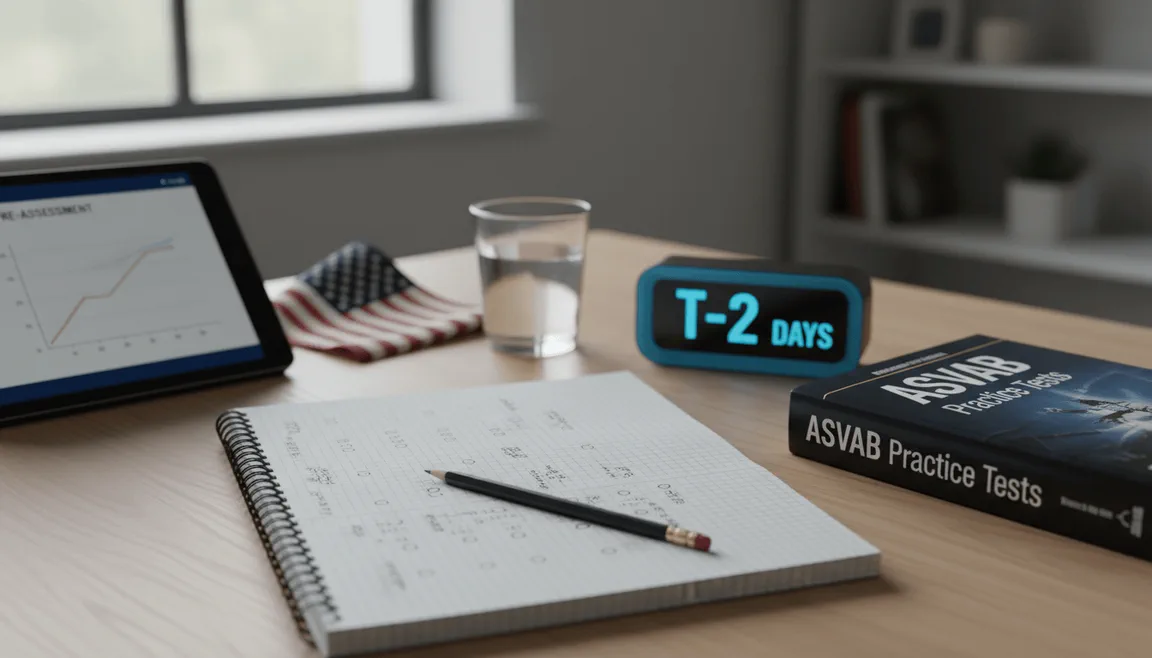
An ASVAB pretest is a diagnostic practice test you take before you start studying, not after. Its job is to show you which of the nine CAT-ASVAB subtests are dragging your score down so you can spend your study hours where they actually count. Take it cold, score it honestly, and use the results to build your study plan. Most people who take a pretest with zero prep land somewhere between the 30th and 50th AFQT percentile, which is normal and fixable.
What is an ASVAB pretest?
A pretest is any full or near-full practice test you take before opening a study guide. The content is the same as any other ASVAB practice test. What makes it a pretest is the timing and the purpose. You are not trying to score well. You are trying to get an accurate picture of where you stand right now.
That last part matters. If you look up vocabulary words mid-test or give yourself extra time on math, the results will point your study plan at the wrong subjects. Treat it like the real thing, wrong answers included.
Why take a pretest before studying?
Studying without a diagnostic usually means studying what feels comfortable. People who like math drill more math. People who read a lot review vocabulary they already know. A pretest breaks that habit by showing you numbers instead of feelings.
It also sets a baseline. When you take another practice test three weeks later, you can compare subtest by subtest and see whether the plan is working. Without a starting score, you are guessing about progress.
What score should you expect on your first try?
Lower than you hope, usually. The AFQT is a percentile from 1 to 99, so a 50 means you did better than half of the reference group, not that you got half the questions right. Plenty of eventual 70s and 80s started with a cold pretest in the 30s.
The branch minimums give you a floor to measure against. Army, Navy, Air Force, and Marine Corps require an AFQT of 31, and the Coast Guard requires 36, with higher minimums for GED holders [NOTE: verify current minimums before publishing]. If your pretest lands above the minimum for your branch, your study plan is about qualifying for better jobs, not just getting in.
How do you read your pretest results?
Look at subtests, not just the overall number. Your AFQT comes from four of them: Arithmetic Reasoning (AR), Mathematics Knowledge (MK), Word Knowledge (WK), and Paragraph Comprehension (PC). The formula is 2VE + AR + MK, where VE is a verbal score built from WK and PC. A weak subtest inside that group hurts you far more than a weak score in General Science or Auto Information.
| Pretest result | What it tells you |
|---|---|
| Low AR or MK | Highest priority. These feed the AFQT directly and respond well to drills. |
| Low WK or PC | High priority. Verbal counts twice in the AFQT formula. |
| Low technical subtests (GS, EI, MC, AI/SI) | Matters for specific jobs, not the AFQT. Fix after the core four. |
| One subtest far below the rest | Focus there first. The fastest AFQT gains come from your worst core subtest. |
How do you build a study plan from the results?
Rank your four AFQT subtests from worst to best, then split your weekly study time so the worst one gets the most attention. A common split is half your time on the weakest subtest, a quarter on the second weakest, and the rest on maintenance for the other two. Retest with a fresh practice test every two to three weeks and re-rank.
Here is the kind of question a pretest throws at you, from the Arithmetic Reasoning bank. A military vehicle travels 60 miles in 2 hours. What is its average speed? The choices are 25, 30, 35, and 40 mph. Speed is distance divided by time, so 60 divided by 2 gives 30 mph. If you missed a question like this under time pressure, that is a rate-problems gap, and it goes on the plan.
ASVABDRILL is an ASVAB practice test platform focused on AFQT improvement, built for military recruits, covering ASVAB, PiCAT, and verification-style practice, so every pretest you take there breaks results down by subtest automatically.
FAQ
Is the ASVAB pretest the same as the real ASVAB?
No. A pretest is a practice test used as a diagnostic. The real ASVAB is administered at a MEPS or MET site (or as the PiCAT at home with later verification). No practice test uses the actual test questions.
How long should a pretest take?
A full-length pretest runs about two hours, matching the real CAT-ASVAB pace. If you are short on time, a timed test covering the four AFQT subtests still gives you a usable baseline in under an hour.
What if my pretest score is below 31?
That is a starting point, not a verdict. Focus on AR, MK, WK, and PC, since those are the only subtests in the AFQT. Most people below 31 on a cold pretest have one or two specific gaps, often word problems or vocabulary, rather than a general problem.
How often should I retake a diagnostic?
Every two to three weeks. Retesting more often than weekly mostly measures noise. Retesting less often than monthly means you can drift for weeks on a plan that is not working.
Related reading
- ASVAB Practice Test
- Free ASVAB Practice Test
- ASVAB Full Practice Test
- ASVAB Practice Test With Score
If you are ready to take your pretest, start with a full-length timed run at /practice-tests and use the subtest breakdown to build your first study week.